CLICK HERE FOR BLOGGER TEMPLATES AND MYSPACE LAYOUTS »
Showing posts with label medieval. Show all posts

Sunday, January 18, 2015

Lindsay Townsend: Medieval curses and more

Medieval people believed in magic, both good and bad. Spells and charms cast with evil intent were called curses and several have survived from that time. The Anglo-Saxons believed in both charms and curses, including a curse chanted against a wen or boil. The little wen is told to go away, to become smaller and vanish into nothing (Her ne scealt thu timbrien, it says - “Here not build your timbered house.”)

The Vikings also believed in the power of words and words for magic and curses. In one saga a witch called Busla issues a curse against King Hring, who has captured and threatened to kill Busla’s foster son. The curse is chanted at night (a good time for such dark matters) and Busla’s magical threats are made manifest.  In lines of poetry, the witch claims that her curse will cause Hring to go deaf, make his eyes to the leave their sockets,  make his bed like burning straw and make him impotent. In addition, any horse he rode would take him to trolls– and more.
“Shall trolls and elves and tricking witches,
shall dwarfs and etins (giants) burn down thy mead-hall…”
 The king is still reluctant and  Busla chants the strongest part of her curse, magic so dark that she does not utter it at night but which will cause Hring to be torn into pieces and flung into hell.  Faced with these gruesome outcomes, the king swears an oath to release his captives. The witch then stops the curse.

Curses could be used both as items to propel malice and as a curious form of protection. Curses were often attached to medieval and Anglo-Saxon wills, mostly to ensure the last wishes were observed, or for more day to day purposes.  The will of Siflaed (composed between 1066-68, soon after  the Norman conquest of England, which may explain the strength of the curse)  states “Whoever alters this, may God turn his face away from him on the day of judgment.”   The Will of Wulfgyth, dated 1046, promises that anyone who detracts from his will shall be denied all human comfort and joy and be delivered into hell “and there suffer with God’s adversaries without end and never trouble my heirs.”  

This form of invoking God by means of a curse to protect others remained popular throughout the Middle Ages.  In 1407, the Will of Thomas of Tyldeslegh gives a hundred shillings of silver to a John Boys to make him an apprentice in a trade and “If anyone hinder this, may God’s curse be upon him.”
                                                 
Curses could be used by medieval people everywhere and in all circumstances. When a monk  in 1420 discovered that the monastery cat had peed  on the manuscript he had been copying, the monk cursed the cat and recorded his curse—with a small drawing, showing pointing hands toward the cat pee—

Hic non defectus est, sed cattus minxit desuper nocte quadam. Confundatur pessimus cattus qui minxit super librum istum in nocte Daventrie, et consimiliter omnes alii propter illum. Et cavendum valde ne permittantur libri aperti per noctem ubi cattie venire possunt.

Which translates as:

Here is nothing missing, but a cat urinated on this during a certain night. Cursed be the pesty cat that urinated over this book during the night in Deventer and because of it many others [other cats] too. And beware well not to leave open books at night where cats can come.


Curses as medieval swear words can be found in this article here:

The ultimate curse could be considered to be excommunication, where a person and a person’s soul is cut off from God and the comforts and body of the church. This was feared as a terrible punishment but was not seen as being permanent, since a person could make amends and have the excommunication lifted.  Bishops and popes used excommunication as a political weapon and means of control.

 Objects could also be used in a malicious way. An amulet containing such vile materials as human waste, a splinter of wood from a gibbet or menstrual blood might be hidden under a bed to cause anything from impotence to sickness. Corpses of dead animals, such as black mice, were sometimes wrapped in cloth and buried under a threshold to create trouble for the inhabitants. Sympathetic magic, where a witch would ‘milk’ a knife stuck in the wall of her cottage, would enable her to steal milk from a cow. In Lucerne in 1486 2 women were accused of making hail by pouring well water over their heads. In Coventry in the 14th century a sorcerer created a wax figure of his neighbor, then drove a spike into the figure’s head and then heart. The neighbor died. In the 1130s the Jews of Trier were accused of making a wax figure of the archbishop and melting it in a fire to cause his death.

Some people were believed to have the power in themselves of cursing others, particularly if members of their family had been accused of sorcery. In 1454 at Lucerne a woman called Dorothea  was widely believed to be an ill-wisher—her mother had been burned as a witch and Dorothea, being unpopular, was accused in her turn.

Certain things were considered to be inherently cursed or evil in the Middle Ages. The wood of the elder tree was believed to be unlucky (it was said Judas had hung himself from an elder tree)and it was also thought to be a witches’ tree. Elder wood can easily splinter, so strictures against its use were in some ways sensible.  Juniper was another plant with a mixed reputation. Although a sprig of juniper was believed to protect the wearer from curses, to dream of juniper was said to foretell bad luck or a death.

What could protect against curses? Rowan was said to be a strong protector. The rowan tree, taken from the Norse “runa” meaning charm, was often planted close to houses to protect the household  against evil. Around Easter time medieval people would make small crosses from rowan wood to give further safety to the house.

Illness, famine, flood, plague and all manner of misfortunes in the Middle Ages were believed to be either due to God’s anger (as with the Black Death) or the result of a curse. Given the state of knowledge about the natural world at that time, the idea of deliberate evil by a person (or in some cases an animal) makes a strange kind of sense. Moreover people were comforted when they could use prayers, amulets, witch bottles and, in extreme cases, the law to protect themselves against the occult forces.

Belief in magic was strong in the Middle Ages. I write about curses and have characters use, or fight against them, in Dark Maiden, The Snow Bride and A Summer Bewitchment . I touch on the idea of God's anger and the Black Death in To Touch the Knight and belief in magical creatures in The Virgin, the Knight and the Unicorn 


Friday, July 4, 2014

Lindsay Townsend: Forever his - slaves in my fiction

Roman woman and her slave
(Photo Giovanni dall'Orto, Peiraius
Museum (Wkimedia Commons).
Writing about the ancient and medieval worlds as I do I often encounter slavery as a fact of life. I explore this dynamic in some of my stories, in a careful way. Slavery was often utterly cruel and the harsh realities of life on the latifundia farms of Ancient Rome could be terrible.

For some slaves life could be a little easier, especially in personal, one to one relationships. So we have the tombstones of former slaves such as Regina (Queenie) at the ancient Roman fort near South Shields. Regina was a former slave, freed by her master who had married her. I explore that kind of hopeful dynamic in my novel Flavia's Secret and my shorter stories, Escape to Love and Silk and Steel.

I show the grimmer side of slavery in my epic adventure romances, Bronze Lightning and Blue Gold. In Bronze Lighting the heroine, Sarmatia, is captured and enslaved for a time by her enemy Carvin, the brutal king of the lands around Avebury. In Blue Gold, several characters are enslaved and must fight to regain their freedom.

Sometimes I explore aspects of submission and dominance in my stories. In my historical romances, I find this works well, fitting into the beliefs of the time. This is especially true in my medieval romances The Snow Bride, its sequel A Summer Bewitchment, and my forthcoming novella, The Virgin, the Knight and the Unicorn. Now with 10% off at Bookstrand until July 8th

I also have one light BDSM novel, Asking Too Much, set in a future where men or women can sell themselves into a consensual 'slavery' for a time.

The dynamics of acceptance and trust inspire me to explore such themes in my work. Bullying does not appeal at all to me but a situation where a man and woman come together in love, trust and respect where the heroine allows the hero to take care of her in masterful ways - that works for me.

You can see my slave and other fiction on my Amazon Author Page here and here

You can also see my slave and other fiction at SirenBookstrand at my Bookstrand Author Page here. This page also links to excerpts and reviews.

Friday, January 3, 2014

Bride for a Champion: new medieval romance at 10% off

I Command you to marry the bearer of this letter.

Lady Alice Martinswood has no choice but to obey her dead father’s final instruction. His choice is his champion, the mercenary Simon Paton. To Alice, the handsome, arrogant Simon is a dangerous, seductive stranger.

Bewitched in turn by Alice, Simon is appalled when he discovers that Alice’s father disowned Henrietta, her younger sister, when Henrietta fell in love and eloped. Simon promises Alice that he will help her find her sister.

Still having nightmares after witnessing the sack of Constantinople, Simon misunderstands Alice’s tears of joy on their wedding night. Swearing not to hurt her again, he decides he must not touch her—a promise he finds impossible to keep, especially when Alice vows to beguile him…

Meanwhile Simon and Alice trace Henrietta to medieval London, wandering together through the perilous, exciting streets. Will they find Henrietta? Will they find true love with each other?

Available on January 14, 2014 at $2.99

Pre-order now at 10% discount from Bookstrand Publishing (pre-order price $2.69)

Lindsay Townsend http://www.bookstrand.com/Lindsay-Townsend

Thursday, January 5, 2012

The Snow Bride - two lovely reviews!

She is Beauty, but is he the Beast?

Read Chapter One

Read Reviews:

The Celtic Rose

Ms. Townsend's tale of these two lonely people joining forces to track him to his lair is non-stop, rich and lyrical. Her voice is distinctive, her writing style a delight, and the ending is both satisfying and promising in that a sequel would be possible. 4 Celtic Roses.

Sizzling Hot Book Reviews

The Snow Bride is and entertaining medieval love story, one of my favorite kinds. I enjoyed that Magnus is willing to woo Elfrida by treating her as an equal, no matter how hard it is for him to do. They have their ups and downs as they learn each other, leading to confusion and doubt on occasion. Both are well rounded, sometimes stubborn and proud characters, and willing to give and take to work together to rescue Elfrida’s sister. I enjoyed the glimpses of life at a noble’s castle, the look at the peasant’s and villages life styles. The banter between Magnus and Elfrida was entertaining, as was the growing love between The Snow Bride and Magnus. 4 Hearts.

Buy the ebook:

Bookstrand

Lindsay Townsend

Wednesday, December 28, 2011

Rites of Winter - Medieval Christmas Revels

By Lindsay Townsend
Make we mery, both more and lasse,
For now ys the tyme of Chrystymas
(From a 15th century carol)

When Christianity developed in the ancient Roman world, the winter solstice was already marked at 25th December. Followers of Mithras believed in the ‘unconquered sun’ and also held a feast-day for the sun on December 25th.

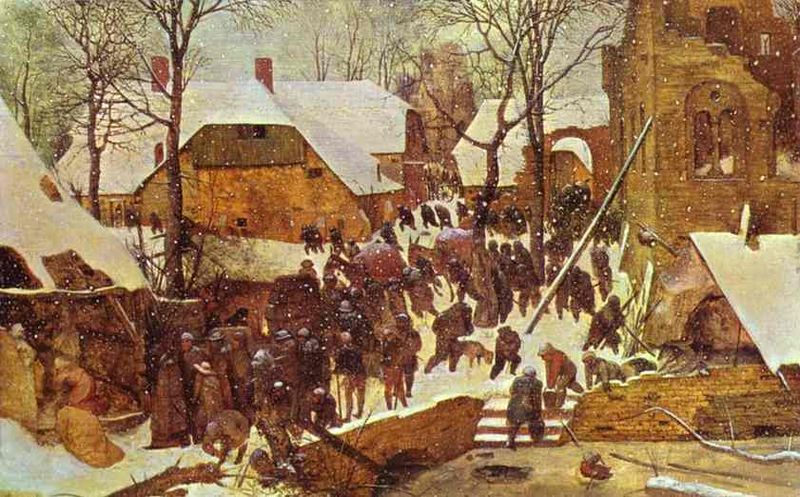
Pieter Breugel the Elder - 'The Visit of the Magi at Christmas'
The gospels did not give a date for the birth of Jesus, but ancient beliefs in the Roman Saturnalia, the solstice and sun-worship led to the church choosing December 25th as the time of his nativity.

‘Christmas’ means ‘Christ’s Mass.’ In England in the Middle Ages three masses were celebrated on December 25th - the Angel’s Mass at Midnight, the Shepherds’ Mass at dawn and the Mass of the Divine Word during the day.

Before the three masses of Christmas there was the forty days of Advent. Advent was similar to Lent, a time of spiritual reflection and preparation for the coming of Christ. Feasting and certain foods such as meat and wine were meant for be abstained from during advent (something the evil Denzils ignore in my historical romance, The Snow Bride, set at this time).

The feasting and revelling time of medieval Christmas began on Christmas Eve and lasted 12 days, ending on Twelfth Night. There was no work done during this time and everyone celebrated. Holly, ivy, mistletoe and other midwinter greens were cut and brought into cottages and castles, to decorate and to add cheer.

The most important element of the revels was the feast. Christmas feasts could be massive – Edward IV hosted one at Christmas in 1482 when he fed and entertained over two thousand people. For rich medieval people there was venison or the Yule boar, a real one, and for poorer folk a pie shaped like a boar, or a pie made from the kidney, liver, and other portions of the deer (the umbles) that the nobles did not want – to make a portion of ‘umble pie'. Carefully hoarded items were also brought out and eaten and other special Christmas foods made and devoured. Mince pies were made with shredded meat and many spices. ‘Frumenty,’ a kind of porridge with added eggs, spices and dried fruit, was served. A special strong Christmas beer was usually brewed to wash all this down, traditionally accompanied with a greeting of 'wes heil' ('be healthy'), to which the proper reply was 'drinc heil'.

There were also other entertainments apart from eating and drinking – singing, playing the lute or harp, playing chess, cards or backgammon and carol dancing.

Presents and gift giving was originally not part of Christmas but of New Year. Romans gave gifts to each other at Kalends (New Year) as well as a week earlier at Saturnalia, and by the twelfth century it seems that children were already receiving gifts to celebrate the day of their protecting saint, St. Nicholas, and the practice soon began to extend to adults as well, initially as charity for the poor. As the Middle Ages wore on, the custom grew of workers on medieval estates giving gifts of produce to the estate owner during the twelve days of Christmas - and in return their lord would put on all those festivities.

Wes heil!

Lindsay Townsend
http://www.lindsaytownsend.net/

Saturday, December 17, 2011

Warm up your winter: 'The Snow Bride'

She is Beauty, but is he the Beast?

Elfrida, spirited, caring and beautiful, is also alone. She is the witch of the woods and no man dares to ask for her hand in marriage until a beast comes stalking brides and steals away her sister. Desperate, the lovely Elfrida offers herself as a sacrifice, as bridal bait, and she is seized by a man with fearful scars. Is he the beast?

In the depths of a frozen midwinter, in the heart of the woodland, Sir Magnus, battle-hardened knight of the Crusades, searches ceaselessly for three missing brides, pitting his wits and weapons against a nameless stalker of the snowy forest. Disfigured and hideously scarred, Magnus has finished with love, he thinks, until he rescues a fourth 'bride', the beautiful, red-haired Elfrida, whose innocent touch ignites in him a fierce passion that satisfies his deepest yearnings and darkest desires.

Coming Dec 27th from Bookstrand Publishing 2011
15% discount until January 3! Pre-order here.

Read Chapter One

Here is another excerpt to tempt you:

Magnus was worried. The fire he had made should have brought his people. It was an old signal, well-known between them. His men should have reached the village by now—that had been the arrangement. They were bringing traps and provisions in covered wagons, and hunting dogs and horses. He had been impatient to start his pursuit of the Forest Grendel and so rode ahead, returning with the messenger until that final stretch when the man turned off to his home. He had ridden on alone, finding the wayside shrine.

But from then, all had gone awry. Instead of the monster, he had found an ailing witch, and the snowstorm had lost him more tracks and time.

Magnus shook his head, turning indulgent eyes to the small, still figure on the rough pallet. At least the little witch had slept through the night and day, snug and safe, and he had been able to make her a litter from woven branches. He would give his fire signal a little longer and then return Elfrida to her village. There he might find someone who could translate between them.

Perhaps she did have power, for even as he looked at her, she sat up, the hood of her cloak falling away, and stared at him in return. She said something, then repeated it, and he drew in a great gulp of cold air in sheer astonishment, then laughed.

“I know what you said!” He wanted to kiss her, spots and all.

He burst into a clumsy canter, dragging his peg leg a little and almost tumbling onto her bed. She caught him by the shoulders and tried to steady him but collapsed under his weight.

They finished in an untidy heap on the pallet, with Elfrida hissing by his ear, “Why have you done such a foolish thing as to burn all our fuel?”

He rolled off her, knocked snow off his front and beard, and said in return, “How did you know I would know the old speech, the old English?”

“I dream true, and I dreamed this.” She was blushing, though not, he realized quickly, from shyness.

“Why burn so wildly?” she burst out, clearly furious. “You have wasted it! All that good wood gone to ash!”

“My men know my sign and will come now the storm has gone.” He had not expected thanks or soft words, but he was not about to be scolded by this red-haired nag.

“That is your plan, Sir Magnus? To burn half the forest to alert your troops?”

“A wiser plan than yours, madam, setting yourself as bait. Or had your village left you hanging there, perhaps to nag the beast to death?”

Her face turned as scarlet as the fire. “So says any witless fool! ’Tis too easy a charge men make against women, any woman who thinks and acts for herself. And no man orders me!”

Magnus swallowed the snort of laughter filling up his throat. He doubted she saw any amusement in their finally being able to speak to each other only to quarrel. Had she been a man or a lad, he would have knocked her into the snow, then offered a drink of mead, but such rough fellowship was beyond him here.

“And how would you have fought off any knave, or worse, that found you?” he asked patiently. “You did not succeed with me.”

“There are better ways to vanquish a male than brute force. I knew what I was about!”

“Truly? You were biding your time? And the pox makes you alluring?”

“Says master gargoyle! My spots will pass!”

“Or did you plan to scatter a few herbs, perhaps?”

He thought he heard her clash her teeth together. “I did not plan my sickness, and I do not share my secrets! Had you not snatched me away, had you not interfered, I would know where the monster lives. I would have found my sister! I would be with her!” Her voice hitched, and a look of pain and dread crossed her face. “We would be together. Whatever happens, I would be with her.”

“This was Christina?”

“Is Christina, not was, never was! I know she lives!”

Magnus merely nodded, his temper cooling rapidly as he marked how her color had changed and her body shook. A desperate trap to recover a much-loved sister excused everything, to his way of thinking.

She called you a gargoyle! This piqued his vanity and pride.

But she does not think you the monster, Magnus reminded himself in a dazzled, shocked wonder, embracing that knowledge like a lover.

Lindsay Townsend
http://www.lindsaytownsend.net

Wednesday, October 26, 2011

Medieval vampires - dead or alive...

Philip Burne Jones, 'The Vampire' (1897), sourced from Wikimedia CommonsDid people in the Middle Ages really believe in vampires? They certainly believed in ghosts, which they called revenants, from the Latin meaning ‘to return’. It was believed that the unquiet dead, particularly those who had died by violence or by reason of a grudge, would return to haunt the living and try to take revenge on them. These revenants might haunt a graveyard or a particular area, known to them in life, and terrorize the living.

They also believed that the dead could be commanded to rise again and spirits or demons compelled to do a wizard’s bidding, through the dark art of necromancy. A surprising number of priests were interested in these dubious practices as a means of gaining power or knowledge. Priests might also seek to exorcise spirits possessing people, by means of prayer or sacred herbs or charms.

Vampires, however, do not really make an appearance until the fourteenth century. Why then?

In 1348 the Black Death struck Europe. Thousands died and thousands of rotting corpses had to be buried, often in mass graves. Sights of these bodies was often grisly and bloody, and so the idea of the vampire, feeding on the blood of the living, came into force.

Recently a body in a medieval Italian mass grave on the Venetian island of Lazzaretto Nuovo was found with a slab of rock slammed between its jaws – a crude anti-vampire measure. The dead woman was suspected by the grave-diggers of being a vampire, possibly because of gruesome sights around her decomposing body when they had re-opened the mass grave to bury more plague victims. So the frightened grave-diggers put a brick in her mouth to stop her chewing through her shroud and escaping the grave to infect others. A very grisly measure!

In my forthcoming medieval historical romance, The Snow Bride (due out Jan 2012), I don’t mention medieval vampires but I do deal with witchcraft and necromancers. My heroine, red-haired Elfrida, is a witch and wise-woman and through the ‘magic’ of love she helps my scarred hero Magnus. Both Elfrida and Magnus must battle against an evil necromancer – a medieval wizard who summoned spirits and demons – and, in a desperate race against time, recover Elfrida’s younger sister. In The Snow Bride I show medieval magic and beliefs, but not medieval vampires. Maybe in another story?

Happy Halloween!

Lindsay Townsend
http://www.lindsaytownsend.net/
http://www.twitter.com/lindsayromantic

Thursday, September 15, 2011

Beautiful worlds, mainly medieval, and how I create them

There are two 'schools' of historians - optimists and pessimists. The first looks to the positive side of historical events. The latter tends to a more gloomy view. It's the rosy and the grubby views of history.

In creating the past in my stories I tend to the more rosy view of history, apart from where I feel readers need to be shown the 'grubby' side as a contrast, or for high stakes, or to endanger my heroines or heroes. But the worlds I try to create I try to make appealing - and romantic in the uplifting, optimistic sense. I rather celebrate the best in human nature and show the 'best' of past societies and cultures.

So how do I go about it?

First I read. I read children's non fiction books (lots of social history and pictures), general histories, specialist histories and finally original, primary sources where I can - letters, chronicles, laws, coroners' rolls. An amazing amount of detail can be found in the last two. Look at the Sumptuary Laws of the 1300s, aimed at restricting expensive dress - that tells me that everyone in England was dressing as richly as they could. And coroners' rolls give lists of accidents that are both vivid and chilling: a man dies because he fell through his privy floor and drowned in his privy, a child perishes because she falls into the fire. These cases are tragic and horrific but they give clues to the world.

These details are grim, so in my world they would be touched on only briefly, if at all, but I need to know them and use them where appropriate.

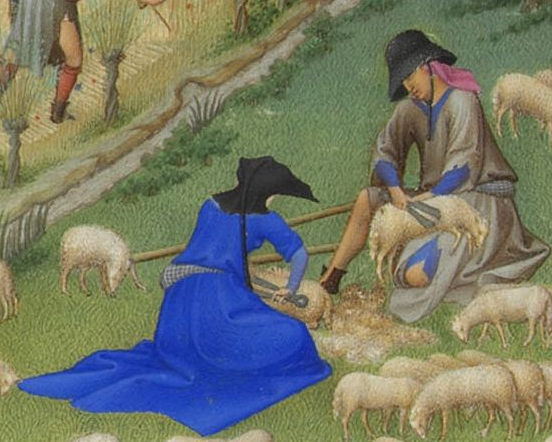
Other more positive details I try to slip into my novels - as deftly as possible, so I don't have slabs of research and a fact-mountain in the middle of my story. For these details I find pictures invaluable. The beautiful drawings of Les Tres Riches Heures of the Duc de Berry show ordinary people at work and play and the world in which they do so. It may be an idealized world, but I find it endlessly inspiring.

I also focus on pleasant things - hobbies, past-times, pleasures and show my characters at play. I also show my characters at work and try to make those sections interesting, in that my people have unusual skills - everyone likes to learn new things.

To build the world I start with geography - the land itself. Where a character lives defines how that person survives on the land and what skills the person will have. Is it wooded and fertile, with soft, rolling hills, or bleaker and harsher? Uplands also have their beauties and I research what animals and plants grow in my fictional kingdom, taking care to include those species which were once common but are now rare. I also take care that my animals and plants are appropriate to the period - in the Middle Ages, I can't have a bunch of English villagers munching on potatoes, which weren't introduced from the New World until much later.

After I have 'made' my land I consider the people. What do they look like? Do they have any unusual aspects in their appearance? Do they have any particular habits of movement, speech or dress? What are they clothed in?

Clothes are always fun for a writer, and for a reader. Roman Britain gives me a lot of scope as there were all kinds of luxury fabrics such as silk available to the rich, plus wonderful jewels. Ancient Roman houses - the ones the rich could afford - can also be shown as very beautiful, with wall paintings and under-floor heating.

After the fall of the Roman Empire the wattle and daub houses that replaced the grand villas might sound drab, but certainly in this country it's the dream of many British to live in a thatched cottage and that is what many of the dwellings were, in essence. When I create them for my beautiful medieval worlds, I stress their snug warmth and living heat.

Returning briefly to clothes, the later Middle Ages also has furs and silks and richly dyed woollens, plus an array of hats and jewels and shoes.

To create a beautiful world of the past I also evoke pleasing sounds and scents - the bells ringing the church hours, the twitter of birds, the rattle of drums, the scent of baking bread, the smell of a bluebell wood - and more.

Selection is the key. As I try to evoke the past and create a beautiful past, I select those details that will transport the reader into fields of wild flowers and colorful, vibrant cities.

It is my pleasure to do so, and I hope it is my readers' pleasure to enjoy the results.

Lindsay
http://www.lindsaytownsend.net/
http://www.twitter.com/lindsayromantic

Saturday, August 27, 2011

Why the Middle Ages fascinate me

I'm Lindsay Townsend and I write historical romances set in the ancient world and the Middle Ages, especially the Middle Ages. Why then?

The Middle Ages covers a huge period of time in the western world, from AD 300 - the rise of the Roman emperor Constantine and the adoption of Christianity as the official religion of the Roman Empire - until the 14th century. This gives lots of scope.

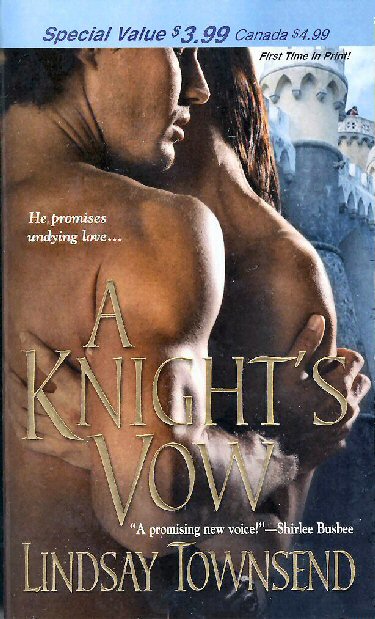
It was a time when religion played a crucial part in people’s lives. The clash of the spiritual and practical was very real. That clash is shown most clearly in the history of the Crusades, when men, women and even children left their homes to travel to the Near East to ‘win’ the holy city of Jerusalem. The motives of such people were mixed and varied, so that mix of emotions - the profound, the greedy, the opportunistic, the generous - fascinate me as a writer. I touch upon the impact that the Crusades and contact with the Arab world had on men and women in ‘A Knight’s Vow’.

The Middle Ages was a time very different to our own, with different beliefs: a pig could be put on trial for witchcraft, a man would be made to prove his innocence by clasping a red-hot iron bar, a woman would be told by the church that she was inferior to her husband and yet still be expected to defend his castle. Alchemy and chemistry were one and the same. The contrast in ideas between then and now fascinate me and I like to show them at work in my romances. In ‘A Knight’s Enchantment’ I have a woman alchemist and she uses her skills to help the hero save his brother.

This was the age of Eleanor of Aquitaine's court of love, of Geoffroi de Charny’s ‘A Knight’s Own Book of Chivalry’ - a how-to book for knights - and Christine de Pizan’s ‘City of Ladies’ - a defense by a woman writer of her own sex. It was a time of the Viking sagas, of troubadours and the chronicles, of many rich and varied sources of information. It was a time of jousts and tournaments, where ladies gave favours and knights vied for honour - jousts I describe in my ‘A Knight’s Enchantment’ and ‘To Touch The Knight’.

But the Black Death came, too, a plague - or series of plagues - that killed almost a third of Europe. The  survivors were traumatized but also had new chances to prosper, something I explore in ‘To Touch The Knight’.

The Middle Ages had many decisive battles that changed the course of history - Hastings, Agincourt, Poitiers, Crécy amongst them. I explore the changes the Battle of Hastings made in my ‘A Knight’s Captive’.

I write romances in which the history serves the hero and heroine and the impact of that history is shown through their lives. The Middle Ages gives me a wonderful backdrop for adventure, high stakes, courtly knights and beastly ones, generous ladies and cruel damsels, peril, good and horrible manners and amazing costumes.

I love the Middle Ages.

Saturday, June 12, 2010

The romance of Vikings

Leif Ericsson arrives in Vinland, from a book of 1908 (source: Wikimedia Commons)Why are Vikings romantic?

When Vikings were raiding Celtic monasteries they were not romantic. When Vikings - unkempt, insanitary, prone to arthritis after years on the sea - ravaged coastal settlements and came upriver to pillage and steal, they were not romantic. When they desecrated Christian sites, they were not romantic.

When an Anglo-Saxon village caught a Viking raider they pinned his skin to the church-door, which took the romance right out of it.

Do real Viking nicknames like 'Geirmund the Shifty', 'Ragnar Hairy-Breeches' or 'Eysteinn the Fart' induce swooning?

So why are we drawn to them?

Perhaps because they were pirates, the free-wheeling buccaneers of their age, who refused to be overwhelmed by anything, including the glories of Byzantine Constantinople - their runes and messages have been found carved into the church of Haghia Sophia in Istanbul.

Perhaps because through their sagas and art they reveal a fierce spirit of independence, a laconic, 'give-it-your best-shot ' attitude that is appealing.

Perhaps because women in Scandinavian society had many freedoms and rights, and at home Viking men were hard-working and respectful to their wives and mothers.

Perhaps because the image of the tall, blond, blue-eyed hulking warrior is a delicious fantasy that - with the benefit of historical hindsight - we can indulge in.

Here, as a partial homage to the romance of Vikings, is my short story, Seal of Odin. This is a different version from my more paranormal story, The Beach and is the earlier of the two:

Seal of Odin (PDF)

Lindsay

Tuesday, June 1, 2010

'A Knight's Enchantment' published today!

My historical romance, A Knight's Enchantment, is released today by Kensington Zebra. This is my third knight novel, the other two being A Knight's Vow and A Knight's Captive. They take place in different time periods and different places, but all have knights as their heroes.

For me the appeal of a knight isn't his shining armour or his wealth. It isn't even the knightly code which he would be supposed to follow: too often in the middle ages, such ideas of courtesy and honour applied only to the nobility and no one else. But a knight as a protector - now that appeals.

My heroines, too, are great rescuers. In A Knight's Enchantment, Joanna is striving to free her father from captivity and throughout the novel she 'rescues' the hero Hugh, prompting him to reconsider many part of his life and his relations with his family.

Their early encounters are fraught, as neither is sure they can trust the other and Hugh especially makes wrong-headed assumptions about Joanna. He has his own powerful reasons for seizing her, but his self-justifications are flawed. Later he realises and admits this and they join forces.

You can find more details, the 4-star Romantic Times review and an excerpt here.

Lindsay

Tuesday, March 23, 2010

Prisoners in the castle: dungeons and oubliettes

The oubliette at Warwick CastleMedieval castles and dungeons tend to go together in people's imaginations and I have set important scenes in A Knight's Enchantment in a dungeon, where the heroine Joanna's father is being held. What we imagine as a typical dungeon, however - dark, underground, no windows, lots of chains - was less common in the Middle Ages than is assumed.

Take the word 'dungeon'. Its earliest form, donjon, meant a keep or tower, a strong defensive position. Over time that tower has been taken to mean a prison, often
underground in a castle. This form of prison was in fact an oubliette (meaning 'forgotten place') and was far darker and more grim than a dungeon, as can be seen in the photo of the oubliette in the castle at Warwick.

Famous dungeons include the Tower of London and those at Pontefract Castle and Alnwick Castle, though true dungeons in castles were not usual until later in the Middle Ages.

Often noble prisoners, captured and held for ransom in the dungeon, would be kept in a secure, comfortable place within the host's castle: certainly the room would be well-guarded, but we should not picture a Richard the Lionheart or Charles of Orleans languishing in the rat-infested, damp stone cell of imagination. Life expectancy in an oubliette would be short, and bad for the ransom business. 'Common' prisoners might be kept in gate houses, while those considered undesirable and disposable but not to be actually murdered could end up down with the rats in the oubliette.

Saturday, November 7, 2009

Time for a roaring fire

After a rainy and recession-dampened Bonfire Night in my neck of the woods, I began to think wistfully of enormous medieval fireplaces, logs cut from the woods by peasants in grubby tunics, the warm glow of a winter fire. Then I thought of a poem about firewood from the 1930s: '..Apple wood will scent your room,/Pear wood smells like flowers in bloom...'

Then I found this picture, February from the Tres Riches Heures du Duc de Berry, which says it all, from the woodcutter in the top right to the fire in the bottom left, blissfully enjoyed by one well-mannered lady in full garb and two pretty unlaced individuals for whom underwear is an optional extra. Ah, the warmth of the open fire....

Lindsay
http://www.lindsaytownsend.net

Saturday, August 15, 2009

The bath-house

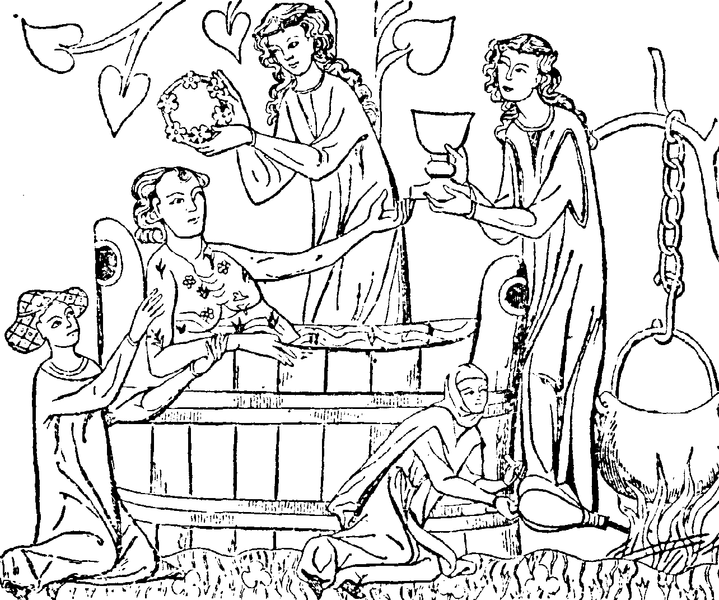
Medieval bathing, from Wikimedia CommonsSetting is always a key element for me - I tend to fix 'where' a story is going to take place early on, so I can research it. I don't have a glitzy city background, or lots of specialist knowledge in a particular sexy field, so I knew that to tempt editors I'd need to place my stories in special settings. Also I find it exciting to research places abroad or in the past - another kind of 'abroad' to me.

So far as room settings are concerned, I love water and I love to bathe, so I've chosen bath-houses as my room for this theme week.

Here's an excerpt taken from my historical romance, Flavia's Secret. In it, Flavia has just gone into the main great bath at Aquae Sulis (Roman Bath: Aquae Sulis - means 'Waters of Sul, the goddess). Sadly, in 206 AD,
when the story is set, her bath is not quite the same as the baths we see today, but I attempted to re-create them from research.

Excerpt: Flavia's Secret.

Leaving her shawl with the unsmiling Rags, she followed Marcus into the great bath, hearing behind her the slap of sandaled and bare feet as new bathers began gathering for the tenth hour—the time any fashionable citizen of Aquae Sulis would aim to be at the baths.
`Wait there a moment, please.' Marcus stopped by one of the pillars close to the rectangular pool and expanse of the great bath and shouted something in a German tongue at a blond, rangy swimmer with only one eye, who raised a fist from the steaming waters and yelled back an answer, in obvious delight.
`I know Otho from Germania—this won't take long,' he said hurriedly to Flavia, grinning as he stepped down the top step of four broad steps at the water's edge and stood waiting, immersed up to his knees, for his former comrade, both arms spread wide in greeting.
Amused at their back-slapping antics—Otho seized Marcus' hand and tried to drag him under the water—Flavia left them to their incomprehensible talk and took in the scene around her.
The great bath was a wonder, she thought, grudgingly acknowledging the powers of the Roman engineering. Set in a huge aisled hall with a soaring barrel vault overhead supported on massive columns, the great bath was surrounded by four deep steps on all sides and its aisle walkways were lined with massive white limestone flagstones. After the dimly-lit corridors leading here, the bath was dazzlingly bright, the light from huge arched upper windows reflected by white limestone columns and smooth plastered walls. The steaming water itself, a pale
green, shimmered with light making the statues lining the bath seem alive.
In the water or waiting in the colonnade were the bathing attendants: slaves holding towels or bottles of scented oil, or strigils to scrape off the oil; masseurs calling out their prices; hair-pluckers flashing their tweezers.
Flavia studied the bathers with narrowed eyes, resting her chin on one hand as she crouched by the base of a statue. She had never been in the baths so late before and she soon understood why, and why some of the women were leaving. The men flooding fast on her heels into the great bath were not elderly veterans. These were a different breed.
She picked out a few figures in the bobbing, chattering mass. There was a magistrate, whom she recognized from one of Lady Valeria's rare dinner parties, swathed in towels as he swept along the side aisle with his entourage and various cronies trailing behind. There was a rich young nobleman with a bored, sulky look, being lifted directly from the bath onto a waiting litter, which bore him away into one of
the hot sweat rooms. There was a massively fat man with a scarlet nose eating a sausage and singing while floating on his back in the water. He was being propelled in the bath by an elderly slave whose
back was still raw with lash marks.
`Don't stare, he is not a forgiving man,' said a familiar voice by her ear.
Flavia turned on the damp limestone. Crouching beside her, his German friend nowhere to be seen, Marcus jerked his head towards the eastern exit.
`Let us get this visit over with and go home,' he said.


I feature bath-houses in my medieval novels, too. Just as today, medieval women and men enjoyed a dip in a warm bath. Monks were allowed to bathe for health reasons, medieval pilgrims still flocked to the baths at Bath in hope of a cure from the warm spring waters. By 1100 AD, hot baths or 'estewes' had been established in London.

These 'stews' could be rather shady places - brothels in fact - but many were simple bath houses. In this excerpt from A Knight's Vow we see the hero and heroine together in a bath house.

Excerpt: A Knight's Vow.

‘I heard about your vow.’
Guillelm did not pause in his stoking of the bath-house fire. He had sent the other men and servants out, but Fulk had entered as if he had a perfect right to be there.
‘Do you not think it a sign from God?’ Fulk continued, in that pious, smug way of his. How had I not noticed this aspect of him before? Guillelm thought, depressed anew. In everything it seemed he was a poor judge, willfully blind. The only skill he appeared to have was in killing.
‘Yes, it is a sign - of my own inadequacy. Boil, damn you,’ he added under his breath to the already steaming tub of water. He longed to be clean, to feel clean. ’I want no one here with me now,’ he growled. He had not forgotten or forgiven Fulk over the man’s mean trick with his wife’s diadem.
His wife - what a reckless dream that had been! Heloise was right: no woman wanted him.
‘Go!’ he snarled and Fulk paled and went, backing out rapidly and skidding down the bath-house steps.
Guillelm hurled more logs into the fire. Presently he heard the door creak and bawled, ’Out!’ without turning round.
‘Where shall I put the towels?’ asked an achingly familiar voice.
He spun round and there she was, Alyson his wife. Even as he gawked at her, longing to beg her forgiveness, to snatch her into his arms, to drag her with him into the steaming bath and frolic there until the water turned cold, his tongue felt nailed to the roof of his mouth. What could he say? He had failed her so badly.
She smiled and he was smitten afresh, more stunned than he had been that time in Outremer, when a stone from a sling had struck him on the visor of his helmet and he had almost blacked out. There was no fear of his losing consciousness now, but certainly she mazed his wits.
‘I shall put them here, shall I, my lord?’
Nimbly, she arranged her armful of towels by the side of the great tub, scattering something on the lapping water that instantly perfumed the bath-house.
‘An old remedy, lavender,’ she explained, lifting her skirts to tread lightly over the flags towards him. ’I have spearmint, too, for our teeth and breath.’
‘Our teeth?’
She did not answer, merely passed straight by him, close enough for him to feel the swish of her robe against his legs, and lit two beeswax candles from the torch. She placed these on the stone shelf beside the tub, where most bathers put their trinkets, or goblets of wine.
‘I find that bath-houses are always a little gloomy, even in summer,’ she remarked. ’Do you not think the candles add cheer?’
They did, and they put a glow into Alyson’s face, warm shadows on the vaulted stone roof of the bath-house and a flickering play of lights on the water. They added little light, if truth be told, but something else instead, a sense of being in a dream.


To end, I do not feel I have explored all aspects of bath-houses and look forward to exploring more in this most sensual and romantic of rooms.

Best wishes, Lindsay Townsend